Why understanding cross-border ownership is critical for KYB compliance
Read more
Share
In my role at Diligencia, heading up our Corporate Intelligence team, I regularly support clients with one of their key needs: identifying ultimate beneficial owners (UBOs). In the Middle East and Africa, the regions we specialise in, there is no one-size-fits-all approach and UBO disclosure laws differ from country to country. Over the past few years, however, we have seen a clear acceleration in regulatory reforms aimed at enforcing UBO transparency, requiring companies to disclose the natural persons who ultimately own or control them. These reforms are driven primarily by the need to combat financial crime, meet international standards (notably those set by the Financial Action Task Force, or FATF), and encourage legitimate investment through stronger corporate governance.
Below I outline some things to be aware of when it comes to understanding UBO disclosure laws in the Middle East.
Table of contents
What is a UBO?
Why UBO laws matter in the Middle East
Key jurisdictional frameworks
Middle East UBO disclosure laws: Jurisdiction comparison table
Common features across Middle East UBO regimes
Business implications and compliance strategies
What is a UBO?
A beneficial owner is a natural person, not just a registered shareholder or legal owner, who ultimately owns or controls a legal entity or benefits from its assets, even if that control is exercised indirectly (e.g., through other entities or layered ownership structures). This concept is central to modern corporate transparency standards and global Anti‑Money Laundering/Counter‑Financing of Terrorism (AML/CFT) frameworks.
Why UBO laws matter in the Middle East
Regional governments have introduced UBO disclosure laws to:
- Enhance corporate transparency and governance.
- Prevent misuse of corporate structures for money laundering, tax evasion, or terrorist financing.
- Comply with FATF recommendations and improve international AML ratings.
- Improve investor confidence and facilitate cross‑border business.
Many Middle Eastern jurisdictions historically lacked centralised beneficial ownership reporting. The latest reforms, however, mark a significant shift toward systematic disclosure and registry maintenance for almost all companies operating in the region.
Key jurisdictional frameworks
Saudi Arabia
In February 2025, Saudi Arabia introduced its first formal UBO disclosure regime, a major development in the Gulf region’s corporate governance landscape:
- Companies must disclose UBO information to the Ministry of Commerce, starting at the incorporation stage.
- A UBO is defined broadly — including individuals with 25% ownership or control and those with significant influence via voting or management rights.
- Firms must maintain a UBO register, update it within 15 days of any change, and annually confirm details with the authorities.
- Exemptions are only given for subsidiaries of companies listed on a Saudi exchange.
- Non‑compliance may attract financial penalties.
United Arab Emirates
In the UAE, UBO disclosure is well‑established and continues to evolve:
- The regime is based on Cabinet Resolution No. 58 of 2020, amended by later decisions (e.g., Resolution No. 109 of 2023).
- Companies must identify and maintain registers of beneficial owners, with weekly reporting obligations and updates within 15 days.
- The UBO framework is tightly coupled with UAE AML/CFT legislation and modern Know Your Customer (KYC) and Customer Due Diligence (CDD) protocols.
- Exemptions exist for certain entities in financial free zones like DIFC and ADGM, which operate under their own frameworks.
- Enforcement actions and penalties are being actively applied, with fines for late or inaccurate disclosures.
The UAE’s system requires companies to keep multiple internal registers and provide detailed personal information about UBOs, though the federal regime does not make such information public.
Qatar
Qatar’s UBO disclosure regime has been in place for several years and is embedded in commercial registry requirements:
- UBO details must be submitted with new or amended commercial registrations.
- Companies must keep UBO registers up to date and report any changes promptly.
- The regulatory framework aligns with the country’s AML/CFT Laws and supports transparent ownership across Qatari businesses.
Qatar has long prohibited bearer shares and require nominee directors/shareholders to disclose their nominators, which helps reveal the natural persons behind corporate ownership.
Bahrain and other Gulf States
Many GCC members, such as Bahrain, Kuwait, Oman, and Qatar, have introduced UBO or beneficial ownership reporting obligations as part of commercial registration procedures:
- In Bahrain, Ministry of Industry, Commerce & Tourism resolution requires disclosure of UBO information at licensing and on changes; non‑compliance can result in fines.
- Kuwait and Oman expanded similar regimes in the early 2020s, each linking beneficial ownership reporting to broader AML/CFT frameworks.
- These systems generally follow the FATF threshold of 25% ownership or control for identifying UBOs.
Middle East UBO disclosure laws: Jurisdiction comparison table
|
Country |
Ownership Threshold |
Reporting Authority |
Reporting Frequency & Updates |
Exemptions |
Penalties for Non-Compliance |
|
Saudi Arabia |
25% ownership or significant control |
Ministry of Commerce |
At incorporation, update within 15 days of change, annual confirmation |
Subsidiaries of companies listed on a Saudi exchange |
Fines, administrative penalties, potential restrictions on business activity |
|
United Arab Emirates (UAE) |
25% ownership/control (direct or indirect) |
Ministry of Economy & relevant free zone authorities |
Submit upon incorporation; update within 15 days of change; weekly reporting in some zones |
Listed companies, government entities, certain financial free zone entities (DIFC/ADGM) |
Fines, suspension of business activity, reputational scrutiny |
|
Qatar |
25% or more ownership/control |
Ministry of Commerce & Industry |
At commercial registration; update promptly on changes |
Government-owned entities |
Fines, administrative penalties, potential suspension of registration |
|
Bahrain |
25% ownership/control |
Ministry of Industry, Commerce & Tourism |
At licensing; update on change |
Government entities |
Fines, license restrictions |
|
Oman |
25% ownership/control |
Ministry of Commerce, Industry & Investment Promotion |
Upon registration and when ownership changes |
Government entities |
Fines and administrative measures |
|
Kuwait |
25% ownership/control |
Ministry of Commerce & Industry |
At registration and update as needed |
Government entities |
Fines and administrative enforcement |
Common features across Middle East UBO regimes
While details vary, most Middle Eastern UBO laws share several characteristics:
1. Ownership thresholds
UBOs are generally defined by ownership/control of 25% or more of shares or voting rights, either directly or indirectly. This aligns with international standards and helps ensure real owners are identified.
2. Register requirements
Companies must keep a UBO register that contains detailed information such as:
- Full legal name
- Nationality and identification details
- Residential address
- Ownership/control percentages
- Dates of becoming/ceasing to be a UBO
These registers are typically not public, but must be made available to regulators.
3. Ongoing reporting and updates
Businesses are required to update authorities promptly — often within 15 days — of any change in beneficial ownership. Annual confirmations of existing information are also standard.
4. Exemptions and special cases
Most regimes exempt:
- Government‑owned entities
- Listed companies subject to separate transparency obligations
- Financial free zone entities under parallel regulatory regimes
5. Penalties for non‑compliance
Penalties vary by country but often include:
- Fines
- Suspension of business activity
- License restrictions
- Reputational damage and increased regulatory scrutiny
For example, fines can range from tens of thousands of AED in the UAE to hundreds of thousands of Saudi riyals in Saudi Arabia for failure to comply with UBO reporting obligations.
Business implications and compliance strategies
For multinational and local companies navigating UBO laws in the Middle East, my advice includes:
- Review corporate structures thoroughly - Complex ownership chains through holding companies, trusts, or nominee arrangements can obscure real owners. Clear identification methodologies are essential.
- Align with AML/CFT and KYC procedures - UBO disclosure is an integral part of broader compliance frameworks. Integrate it with customer due diligence and risk assessments.
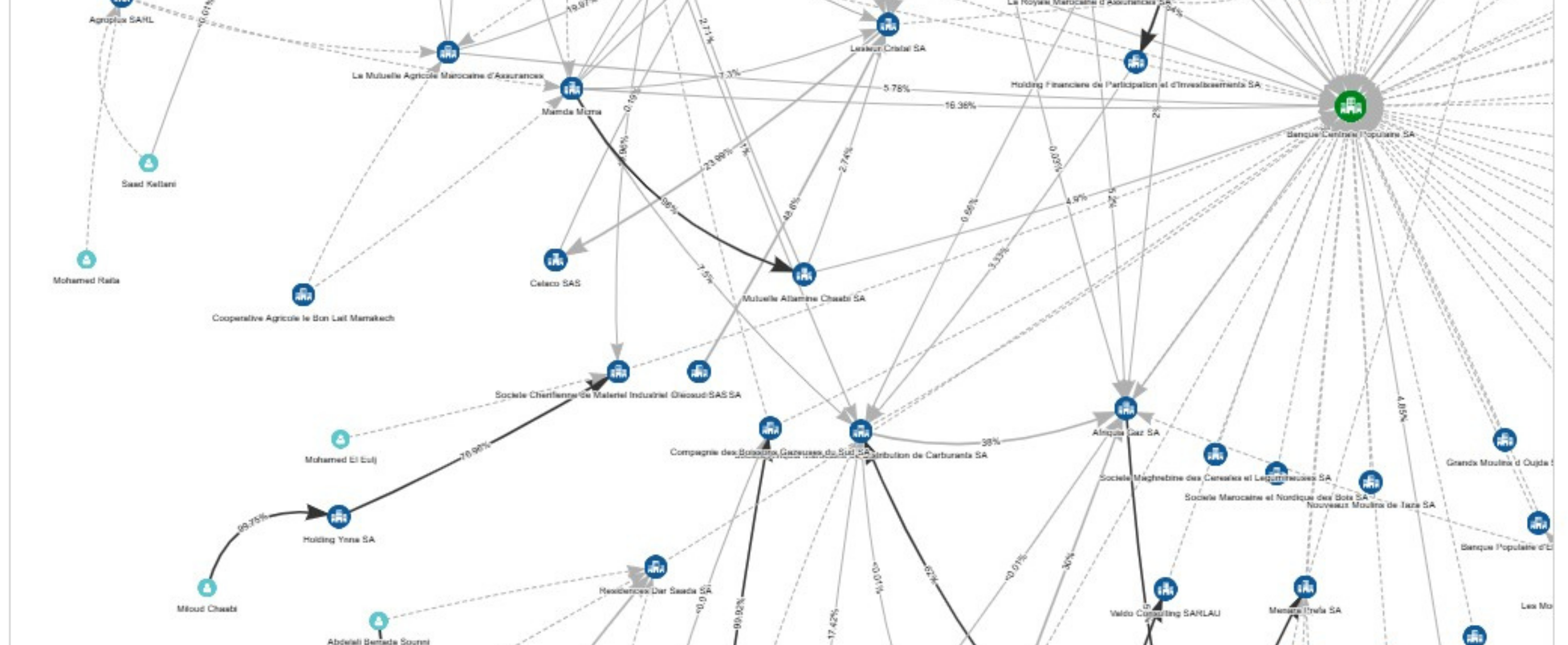
- Partner with a trusted data provider - Work with a company such as Diligencia, to identify UBOs and ownership structures across borders. Diligencia’s online platform – ClarifiedBy – makes it easy to visualise UBOs via it’s UBO Explorer interactive diagram (see example below).
UBO Explorer interactive diagram on ClarifiedBy
About the author
Mina Mouhoub, Managing Director - Operations
Mina leads Diligencia’s consulting and due diligence solution team, working on a range of business intelligence and investigations, such as enhanced due diligence, international asset tracing, and supporting clients entering new markets in unfamiliar or high-risk jurisdictions. Prior to joining Diligencia in 2016, Mina was engaged with a global economic research and consultancy firm. She speaks native-level Arabic, French and English.
About Diligencia
Diligencia helps customers from around the world to find essential information on organisations registered in Africa and the wider Middle East, drawing on primary sources that are otherwise hard to find. Using our curated data, we enable our clients to effectively manage their compliance obligations, allowing them to continuously monitor their suppliers and counterparty risks in the MEA region.